Pricing
Is a $500/Month AI Agent Worth It?
Decide whether a $500 managed AI agent is worth it using one workflow, your real operating cost, and a clear fit test—not speculative ROI claims.

A $500-a-month AI agent is worth it when one or two recurring jobs reliably cost you more than $500 in time, missed follow-through, or paid help—and the service takes responsibility for keeping those jobs running. It is not worth it when you mainly want occasional answers, enjoy building the system yourself, or cannot name a specific result you would delegate.
That is the short answer. The honest calculation starts with a workflow, not a promise about “transforming your business.”
What are you buying for $500?
An AI model is only one part of a working agent. Someone still has to configure the job, connect the right tools, set approval boundaries, keep the environment available, fix broken connections, update instructions, and handle exceptions.
A self-serve subscription leaves most of that operating work with you. A managed service bundles more of it into the price. MyAgnts' current Private Operator plan is $500 per month, including AI usage, a private persistent environment, personal setup, ongoing maintenance, and support.
You are not buying an infallible employee. You are buying a maintained system for bounded digital work. A person still owns the goal, reviews consequential actions, and decides when the workflow needs to change. If you want the broader cost anatomy first, read our AI agent cost guide.
Compare the job, not the monthly fee
Choose one job you already do. Make it concrete:
Each weekday, review the approved inbox, prepare replies for routine messages, and flag anything that needs my judgment.
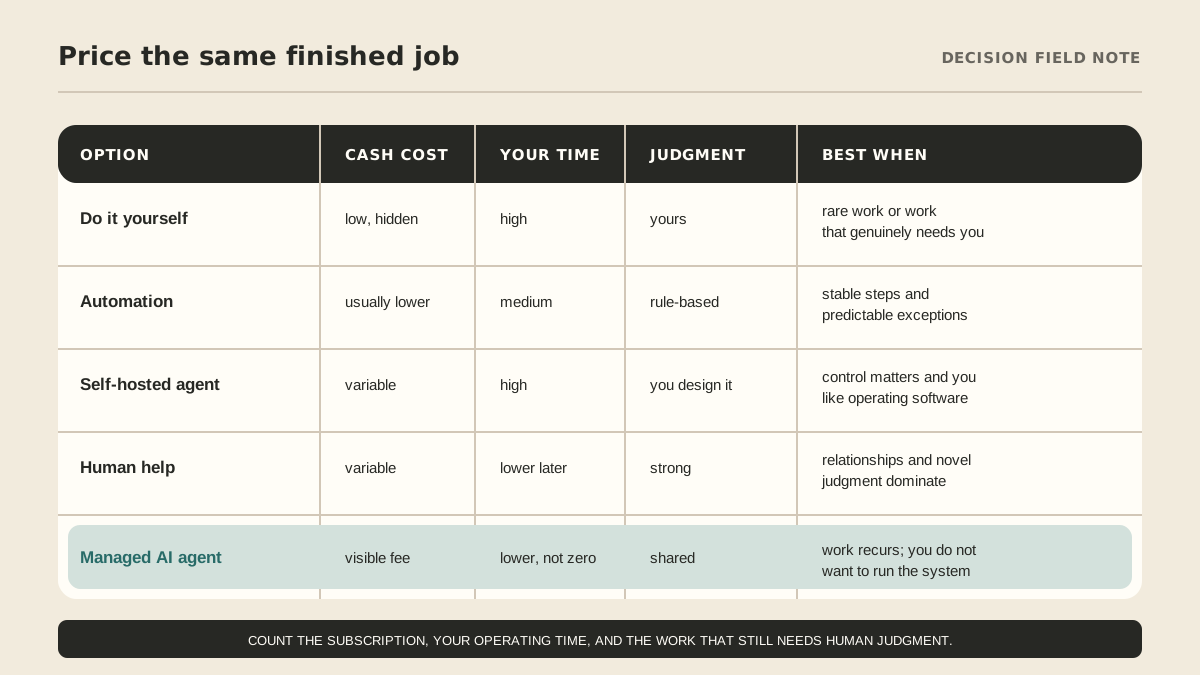
Now compare ways to get that same result. A low-cost software plan and a $500 managed service are not alternatives if the first still needs four hours of your setup, checking, and repair every month.
| Option | Cash cost | Your operating time | Judgment | Best when |
|---|---|---|---|---|
| Keep doing it yourself | Low and hidden | High | Yours | The work is rare or genuinely needs you |
| Automation tool | Usually lower | Medium | Rules handle most cases | The steps are stable and deterministic |
| Self-hosted agent | Variable | High | You design the boundaries | You want control and like operating software |
| Human assistant | Variable | Lower after onboarding | Strong | Relationships and exceptions dominate |
| Managed AI agent | Higher visible fee | Lower, not zero | Shared through approvals | The work recurs and you do not want to run the system |
The cheapest line depends on the job. Calendar rules may need a simple automation. An upset customer needs a person. A recurring mix of research, triage, monitoring, and draft follow-up may suit a managed agent.
Calculate your break-even point
Do not start with a generic hourly-rate statistic. Use your own numbers.
- Track the time the job takes for two normal weeks.
- Add time lost to restarting, checking status, and fixing missed steps.
- Give that time a conservative value. Use what you pay for equivalent help or the value of the work it displaces.
- Subtract the time you would still spend reviewing the agent's work.
- Add any cash cost the agent could replace, such as a separate monitoring tool or a small block of routine contractor hours.
Use this planning formula:
monthly value returned = (hours removed × value per hour) + costs replaced − review and correction cost
Suppose a recurring job takes eight hours a month and you conservatively value those hours at $75. That is $600 of capacity. If reviewing the agent still takes an hour, the case is weaker. If the same workflow also prevents a follow-up queue from going stale, the case may be stronger—but only count that value after you can observe it.
This is not a guarantee. It is a threshold to test in a bounded pilot.
When a managed AI agent is probably worth it
The case becomes stronger when several of these are true:
- The work happens every week, not twice a year.
- It lives in digital tools the agent can reach with narrow permissions.
- “Done” is recognizable: a brief delivered, a queue cleared, a change reported, or a draft prepared.
- The work follows a pattern but still contains small exceptions.
- Delays or dropped follow-ups matter.
- You can review important actions before they affect people, money, or public records.
- You would rather shape the workflow than maintain servers and integrations.
That last point separates a managed AI agent from software you operate yourself. Management is part of what the fee buys.
When it is not worth it
Do not pay $500 a month because the technology is impressive. It is a poor fit when:
- you mainly want brainstorming, writing help, or occasional research;
- the job is too vague to test;
- almost every case requires sensitive human judgment;
- you will not grant the minimum access needed for the result;
- the monthly work is worth less than the subscription;
- you want complete infrastructure control and are comfortable self-hosting; or
- you expect the agent to replace ownership of the business decision.
A general assistant, a focused automation, or a person may be the better choice. Our AI-versus-human assistant comparison gives a practical way to divide the work.
Ask these questions before paying
A provider should answer these without hiding behind a feature tour:
- What exact workflow will be live first?
- What setup, usage, hosting, updates, and support does the fee include?
- Which actions can the agent take, prepare, or only suggest?
- How much review time should I expect?
- Who fixes a failed schedule or broken connection?
- What evidence will show that the workflow is saving time or improving follow-through?
- How can I stop the workflow and revoke access?
If the answers are vague, the price is not yet the problem. The scope is.
Make the decision with one real workflow
Pick a job you would be relieved not to carry next month. Measure its current cost, define the result, and compare every option against that same result. Then test the smallest useful version.
MyAgnts is built for owners who want a private operator to handle recurring digital work without becoming the system administrator. The managed service page explains what the $500 plan includes. If the fit still looks plausible, book a 15-minute setup call. No workflow prep is required; a useful call should still be able to end with “this is not worth it for you yet.”