Guides
Small-Business Hiring Shortage: A Practical Capacity Plan
Can't find qualified employees? Redesign the role, widen the pool, train, contract, automate, or hire using this practical capacity framework.

When a small business cannot find qualified employees, the immediate reaction is often to repost the same job, raise the salary, or keep absorbing the work. Sometimes one of those choices is right. Often the real problem is that the opening combines several different kinds of work and asks one candidate to arrive ready to do all of them.
A better response is to treat the vacancy as a capacity problem before treating it as a recruiting problem. Define the work, identify the actual constraint, and decide task by task whether to redesign, train, contract, automate, or hire.
This guide includes a diagnostic, a role-to-capacity matrix, a clearer job-post template, and a 30-day bridge plan.
Is there still a small-business hiring shortage?
Hiring difficulty remains real, but national figures are context—not a diagnosis of your opening.
In its June 2026 jobs report, the National Federation of Independent Business said 32% of surveyed owners had job openings they could not fill. Skilled positions were harder to fill: 27% reported openings for skilled workers, compared with 12% for unskilled labor. The report reflects NFIB members and the organization's survey method; it does not mean every industry or local market has the same shortage.
The Bureau of Labor Statistics reported 7.6 million US job openings and 5.2 million hires in May 2026. Those economy-wide totals describe movement in the labor market, not whether your pay range, schedule, location, or requirements can attract the people you need.
Use the data to reject one unhelpful conclusion: a slow search does not automatically mean your business is uniquely broken. Then investigate the opening on its own evidence.
Diagnose why qualified applicants are not appearing
Pull the last four to eight weeks of recruiting data into a simple funnel:
job views → applications → qualified screens → interviews → accepted offers
The stage with the sharpest drop suggests the next question.
| Symptom | Likely constraint to investigate | First useful check |
|---|---|---|
| Few job views | Reach, title, channel, location | Search the title candidates actually use; compare local postings |
| Views but few applications | Pay, schedule, trust, application friction | Publish the range and normal week; complete the application yourself |
| Applications but few qualified screens | Requirements or targeting | Separate must-have, trainable, and unnecessary credentials |
| Screens but few interviews | Screening criteria or recruiter delay | Audit rejection reasons and response time |
| Interviews but few offers | Assessment or indecision | Use the same scorecard and decision deadline |
| Offers but few acceptances | Compensation, schedule, role clarity, experience | Ask declined candidates one neutral, specific question |
Do not collapse every problem into “no one wants to work.” That explanation cannot tell you what to change.
Check whether the role is over-bundled
Small-business job descriptions often combine operations, customer service, bookkeeping, social media, office management, and “other duties” because one departing employee handled all of them. The bundle may be convenient for the org chart and incoherent to the candidate market.
List every recurring responsibility and add:
- hours per week;
- frequency and deadline;
- skill or license required;
- consequence of an error;
- need for local presence;
- need for company context or judgment; and
- whether the work is stable enough to document.
If the tasks require unrelated specialties, the answer may be two smaller sources of capacity rather than one unusually broad hire.
Check requirements against the work
“Preferred” requirements can behave like mandatory ones. Remove a degree, years-of-experience threshold, certification, or software requirement unless you can name the work outcome it protects.
BLS's Occupational Requirements Survey distinguishes minimum formal education from credentials, prior experience, and on-the-job training. Use the same discipline: decide which qualification is legally or operationally necessary, which predicts performance, and which can be learned.
Do not relax a license, safety requirement, or regulated qualification to enlarge the pool. For everything else, test whether a work sample or structured interview would provide better evidence than a resume proxy.
Check pay, schedule, and location early
Compare the full offer with comparable local roles:
- base pay and realistic variable pay;
- benefits and time off;
- shift timing and predictability;
- on-site, hybrid, or remote requirements;
- commute or travel;
- hours and overtime expectations; and
- the scope of ownership.
A remote role is not automatically better, and an on-site role is not automatically unfillable. The problem is usually a mismatch between what the job requires and what the offer acknowledges. State the constraint honestly instead of surprising candidates late.
Turn the opening into a capacity decision
For each task, choose the smallest safe source of capacity.
| Work pattern | Best first option | Example |
|---|---|---|
| Unclear, duplicated, or low-value | Redesign or stop | A report no one uses |
| Stable, recurring, rules-based | Automate after documenting | Moving approved form data into a weekly summary |
| Specialized and intermittent | Contractor or fractional specialist | Quarterly tax planning or a brand redesign |
| Learnable with feedback | Train an existing employee or promising candidate | A documented inventory reconciliation |
| Durable, judgment-heavy, relationship-rich | Focused employee hire | Owning a client portfolio and resolving exceptions |
The choice is not permanent. A contractor can document a process before a hire takes it over. Automation can prepare information while a person approves the consequential action. Training can reveal whether a full-time role will have enough enduring work.
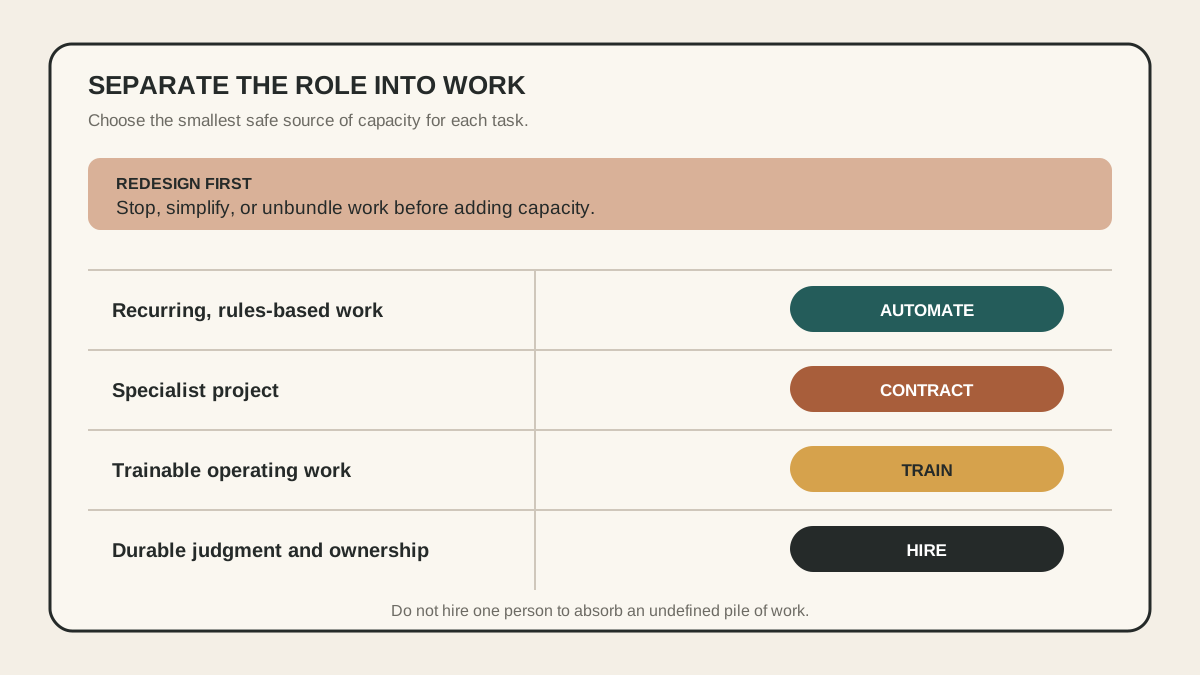
Redesign before you add capacity
Ask four questions:
- What outcome would disappear if this task stopped?
- Is another team already producing the same information?
- Can the frequency or service level change?
- Can the work move closer to the person who already has the necessary context?
Removing two hours of avoidable work is better than finding a cheaper way to perform it forever.
Train where the gap is learnable
Training is viable when the work can be observed, practiced safely, and reviewed by someone competent. Define:
- the starting skill;
- the first independent outcome;
- the practice and feedback loop;
- who can review the work;
- the error boundary; and
- the date you will assess progress.
“Willing to learn” is not a training plan. Neither is giving a new employee an undocumented process that exists only in the owner's head.
Contract for bounded specialist outcomes
A contractor is a strong fit when you need expertise but not continuous ownership. Specify the deliverable, access, decision rights, handoff, confidentiality needs, and how work will be reviewed.
Do not label someone a contractor merely to avoid the obligations of employment. Worker-classification rules depend on the actual relationship and jurisdiction; get qualified advice when the boundary is uncertain.
Automate stable, reviewable work
Automation is useful when the inputs, rules, output, and exception path are clear. Good candidates include gathering approved data, preparing routine summaries, monitoring a defined source, routing requests, or drafting from a controlled template.
Keep a person in control of hiring decisions, employee records, pay changes, legal judgments, and other consequential actions. An automated workflow should surface evidence and exceptions, not quietly reject a candidate or make a binding decision.
The small-business task automation guide shows how to assess repetition, rules, risk, and access before automating. MyAgnts can handle a defined recurring workflow, but the useful promise is narrower than “replace an employee”: reduce the stable work surrounding a role so the human capacity decision becomes clearer.
Hire when the work needs durable ownership
A focused employee hire is usually justified when:
- the work is recurring enough to support the role;
- priorities change and require context-rich judgment;
- the person must build long-term customer or team relationships;
- the business needs availability and ownership, not only a deliverable; and
- you can support the employee with management, tools, and a credible path to success.
Hiring is not the failure case in this framework. It is the right answer for work that benefits from sustained human judgment and belonging inside the business.
Rewrite the job post around evidence
Replace the catch-all description with five sections.
1. Outcome
Start with what this person will make true.
Own the weekly order-to-delivery workflow so customers receive accurate updates and exceptions are resolved within one business day.
That is more useful than “wear many hats in a fast-paced environment.”
2. Normal week
Name the recurring work, collaboration, schedule, and on-site expectations. Candidates should be able to picture the job before applying.
3. Must-have evidence
Keep this list short. Tie every item to an outcome:
- can reconcile records and explain discrepancies;
- can write a clear customer update;
- can prioritize exceptions against a documented service level.
4. Trainable skills
Say what the business will teach: your inventory system, product catalog, internal escalation path, or reporting format. This invites capable candidates who would otherwise screen themselves out.
5. Offer and process
Publish the compensation range where lawful and practical, benefits, location, schedule, interview stages, expected timeline, and contact for accommodations. Check the rules that apply where you recruit; pay-transparency and hiring requirements vary by jurisdiction.
Screen candidates consistently
Use the same job-related questions and scorecard for every candidate at the same stage. Score observable evidence before discussing overall “fit.”
A compact scorecard might include:
| Dimension | Evidence sought | Score |
|---|---|---|
| Task judgment | Identifies the important exception and explains why | 1–4 |
| Communication | Gives a concise, audience-appropriate update | 1–4 |
| Process discipline | Follows and improves a documented sequence | 1–4 |
| Learning | Uses feedback in a second attempt | 1–4 |
A short work sample can reveal more than an unstructured conversation. Keep it representative, time-bounded, accessible, and unrelated to free production work. Pay candidates when appropriate and confirm that your process complies with employment and privacy rules in the relevant jurisdiction.
A 30-day capacity bridge while you recruit
Do not let “temporary” mean undefined.
Days 1–3: stabilize
- name the one owner for each critical outcome;
- pause low-value work;
- set a temporary service level;
- document safety, legal, cash, and customer risks; and
- tell affected people what will change.
Days 4–10: separate the work
- complete the task inventory;
- stop or simplify avoidable tasks;
- assign bounded specialist work;
- identify one trainable responsibility; and
- document one stable automation candidate.
Days 11–20: test capacity
- run the contractor, training, or automation pilot;
- measure hours, errors, cycle time, and exceptions;
- rewrite the job around the remaining durable work; and
- launch a structured sourcing and screening process.
Days 21–30: decide
Review what the vacancy actually contains now:
- Is there enough recurring work for a full-time role?
- Which work still needs judgment or relationships?
- Can the business manage and develop the hire?
- Is temporary coverage creating unacceptable risk?
- What did candidates reveal about pay, schedule, or scope?
Then hire, continue a bounded bridge, or redesign again. Set a review date so an emergency arrangement does not become the operating model by accident.
Small-business hiring shortage FAQ
Why can't my small business find qualified employees?
The market may be tight for the skill you need, but diagnose your own funnel. Low visibility, an overloaded role, unnecessary requirements, an uncompetitive offer, slow screening, and an unclear job post produce different symptoms and require different fixes.
Should I raise the salary?
Raise it when market evidence shows the offer is below the role's real scope or when accepted candidates consistently cite compensation. More pay will not repair an incoherent bundle, a hidden schedule, or a process that takes weeks to respond.
Should I remove degree requirements?
Remove a degree requirement when it is not legally required and you cannot connect it to the work outcome. Replace it with job-related evidence, such as a structured interview or representative work sample. Keep licenses, safety qualifications, and regulated requirements that genuinely protect the work.
Can automation solve a hiring shortage?
Automation can reduce stable, rules-based work around an opening. It should not make consequential employment decisions or be treated as a substitute for the judgment, care, relationships, and accountability a good employee provides.
When should I use a contractor instead of hiring?
Use a contractor for a bounded specialist outcome or temporary bridge when the business does not need continuous ownership. Hire when the work is durable, context changes often, and long-term relationships or internal accountability matter.
Make the vacancy smaller and the role better
The useful question is not “How do I replace this person as fast as possible?” It is:
What capacity does the business need, for which work, with what evidence and risk?
Answer that task by task. You may still make a full-time hire, but the role will be clearer, the screening will be fairer, and the new employee will inherit less accidental work.