Productivity
How to Plan Your Week: A 30-Minute Review
Plan your week with a 30-minute review that reconciles open commitments, checks upcoming deadlines, and makes trade-offs before Monday.

To plan your week, first reconcile the promises already in motion. Review what finished, what stalled, what is waiting on someone else, and what is approaching over the next two weeks. Then decide what you will commit to, maintain, park, and communicate.
This is a weekly review, not a scheduling exercise. It tells you what the week needs to accomplish and which trade-offs are real. Once those decisions are sound, you can place the work on a calendar with the time-blocking guide for founders.
Why weekly planning starts with reconciliation
Most weekly plans are built by adding. You scan a task list, choose new priorities, and carry every unfinished item forward. Nothing leaves, so the plan gets heavier while available time stays the same.
A useful review does the opposite. It closes or renegotiates old commitments before accepting new ones. The result is not a prettier list. It is a current record of what you still intend to do.
Set aside 30 minutes on Friday afternoon or Sunday evening. Open four sources only:
- last week's calendar;
- your main task or project list;
- the place where you capture incoming requests;
- next week's calendar, plus the following week for approaching deadlines.
Do not check every app “just in case.” If commitments regularly live somewhere else, add that location to a short review checklist.
How to plan your week in 30 minutes
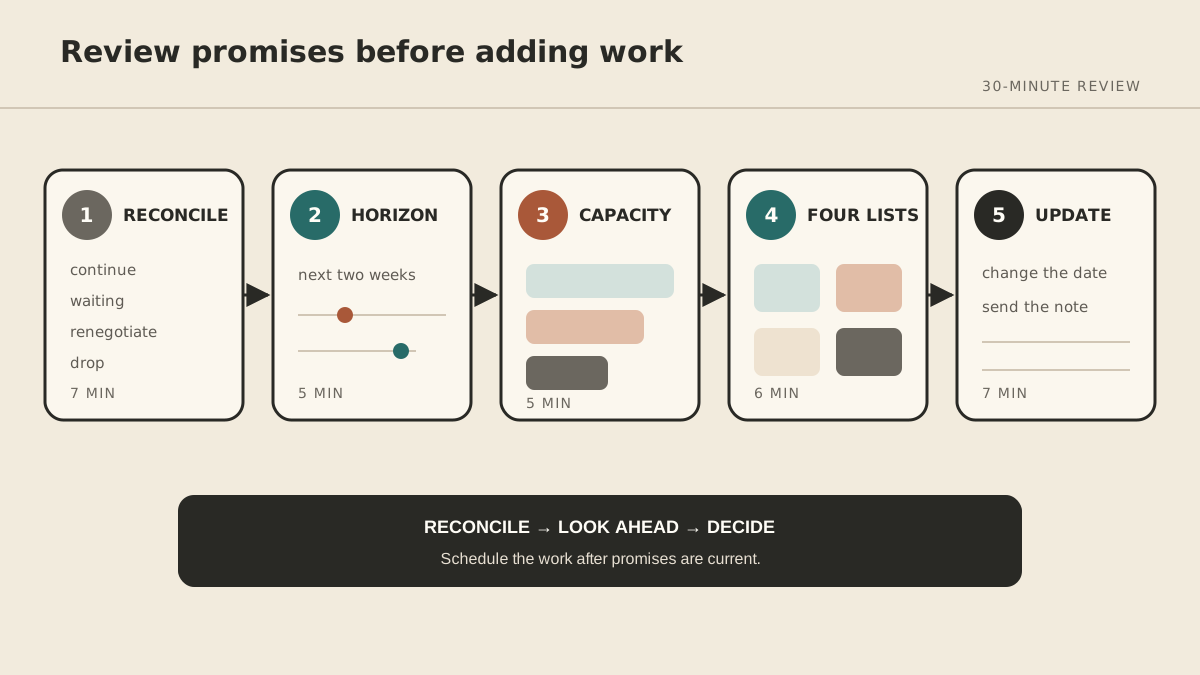
Minutes 0–7: reconcile last week
Start with outcomes, not activity. What became true because of last week's work? What remains unfinished? Which item is blocked?
Give every unfinished commitment one status:
- Continue: it still matters and has a clear next step.
- Waiting: someone else owns the next move; record who and when you will follow up.
- Renegotiate: the scope or date no longer fits reality.
- Drop: the cost now exceeds the value.
Do not use “carry over” as a status. It hides the decision the review is supposed to make.
Minutes 7–12: scan the horizon
Look beyond Monday through Friday. Check the next two weeks for deadlines, travel, launches, renewals, client milestones, and preparation that must begin early.
A proposal due next Tuesday may need review this Thursday. A meeting next week may require data from someone who needs three days' notice. Weekly planning is valuable partly because it exposes that lead time before it becomes urgency.
Minutes 12–17: name the kind of week you have
Classify the week as light, normal, or constrained based on fixed commitments and likely energy—not on how ambitious you feel during the review.
A constrained week might include travel, a launch, several client calls, or caregiving. It should receive fewer new commitments. This is intentionally a judgment call rather than a universal “leave 20% free” rule. Your calendar and recent history are better evidence than a generic percentage.
Ask: What did a week shaped like this actually hold last time?
Minutes 17–23: build four lists
Sort work into four small groups:
| List | Meaning | Required detail |
|---|---|---|
| Commit | Results you intend to finish or materially advance | Definition of done and next checkpoint |
| Maintain | Recurring work that keeps operations healthy | Owner and review time |
| Waiting | Work another person or event must unblock | Owner and follow-up date |
| Park | Valid work you are explicitly not advancing this week | Reason or revisit date |
The Park list is what makes the plan honest. It protects good ideas from deletion without pretending they are active commitments.
If the Commit list is longer than the week can support, rank it until the answer is uncomfortable but plausible. A plan becomes useful at the moment it forces a trade-off.
Minutes 23–27: write checkpoints
Every committed outcome needs one checkpoint visible before Friday. For example:
Outcome: Renewal proposal ready for client review.
Checkpoint: Pricing assumptions approved by Wednesday noon.
Next action: Send finance the three open questions.
Checkpoints expose hidden dependencies. They also let you notice a slipping result early enough to change course.
Minutes 27–30: communicate the changes
Send the short message, move the due date, decline the meeting, or ask for the missing input while the decisions are fresh. Planning is incomplete if everyone else is still operating from the old promise.
Use plain language:
I can deliver A by Thursday or A and B by next Tuesday. Which matters more?
That is better than accepting both and discovering the conflict on Friday.
Copy this weekly review template
Reconcile
Finished:
Continue:
Waiting on / follow up date:
Renegotiate:
Drop:
Look ahead
Deadlines and events in the next two weeks:
Preparation that must start now:
Week type: light / normal / constrained
Decide
Commit:
Maintain:
Waiting:
Park:
People who need an update:
Keep this in the same place each week. A sequence of reviews becomes a useful record of what repeatedly slips, which dependencies recur, and whether you are routinely promising more than similar weeks can hold.
What to do when the week changes
Do not rebuild the entire plan after one disruption. Reopen the four lists and make the smallest honest change:
- move one Commit item to Park;
- shrink the definition of done;
- move a checkpoint;
- ask for help or a decision;
- communicate the new promise.
Record what changed in one sentence. At the next review, you will be able to distinguish bad estimation from a genuinely unusual week.
Automate collection, not trade-offs
A workflow can gather last week's calendar, overdue tasks, approaching dates, and waiting items into a private brief. It should not quietly change client promises or decide which commitment matters most.
MyAgnts can build and maintain that preparation layer from approved sources, with consequential updates left for review. The useful boundary is simple: automate finding and organizing the evidence; keep prioritization and renegotiation with the person accountable for the outcome.
Frequently asked questions
When should I plan my week?
Pick a time you can repeat. Friday keeps the previous week fresh; Sunday can make Monday calmer. What matters is reviewing before incoming work starts choosing for you.
What is the difference between a weekly review and time blocking?
A weekly review reconciles commitments and decides what the week should carry. Time blocking assigns chosen work to specific calendar periods. Review first, schedule second.
How many priorities should I choose?
Use the number your week type and recent history support. One major outcome may be enough in a constrained week. The list should be plausible, not impressive.
If gathering the same commitments and dates consumes the review itself, book a MyAgnts setup call. No task prep is required; we will learn which sources and decisions matter and map a practical setup around them.