Comparisons
Hermes Agent Hosting: Self-Hosted vs. Managed Operator (2026)
Compare self-hosted Hermes Agent with a managed operator across cost, setup, access, review, control, and ongoing responsibility.

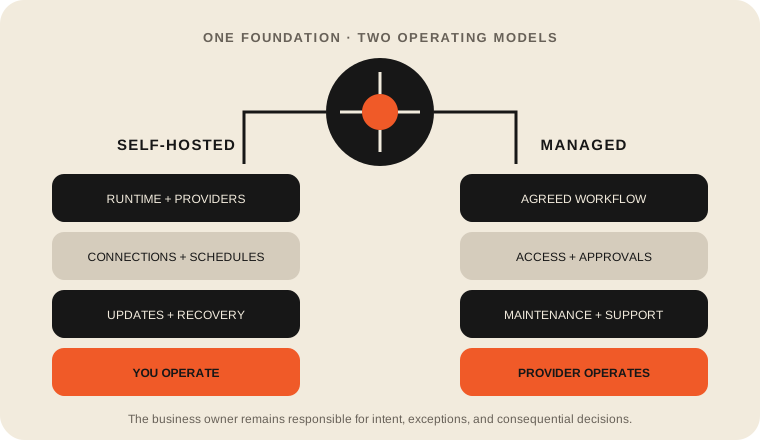
Hermes Agent can be installed and operated directly. A managed operator answers a different question: who owns the environment, connections, updates, and workflow maintenance after the first successful run?
Disclosure: MyAgnts publishes this comparison and sells the managed option discussed below. Self-hosting is a legitimate choice, not a problem invented to make the service look necessary.
Hermes changes quickly. Product claims here were checked against the official installation, quickstart, and tools documentation, plus the current MyAgnts pricing and managed service pages, on September 5, 2026. Recheck those sources before committing a production workflow.
The short answer
Choose self-hosted Hermes when infrastructure control, customization, or learning the system matters more than reducing operating work. Choose a managed operator when you have a defined recurring workflow and want someone else to prepare and maintain the environment.
Neither path removes the human workflow owner. Your business still decides what the agent may do, which actions need review, and when the workflow must change or stop.
Self-hosted or managed? A buyer table
| Decision area | Self-hosted Hermes | MyAgnts managed operator |
|---|---|---|
| Setup | You install Hermes, choose the runtime, configure providers and tools, and test the workflow. | MyAgnts provides personal setup around the first workflow and approved connections. |
| Access and credentials | You choose, store, renew, and revoke model, tool, and channel access. | You approve the minimum access; MyAgnts operates the managed environment and connection setup within scope. |
| Runtime and updates | You select the machine or server and own updates, diagnostics, and recovery work. | MyAgnts maintains the environment and handles updates within the service scope. |
| Review and exceptions | You design the review queue, stop procedure, and escalation path. | You remain the workflow owner; the service is shaped around agreed act, prepare, and ask boundaries. |
| Ongoing cost | Infrastructure, model/tool usage, and your operating time. | The published Private Operator fee is $500/month, plus customer review time and anything outside the published scope. |
| Control | Direct control of files, providers, runtime, and configuration. | Control through the workflow, access, and review boundaries rather than server administration. |
The managed offer currently lists AI usage, a dedicated private environment, personal setup, connections for messages, calendars, files, websites, and tools, persistent memory on encrypted storage, monthly workflow review and tuning, and priority support. Confirm the scope for your workflow before purchase; a feature list is not a promise that every integration or job is supported.
What Hermes provides
The official Hermes documentation describes tools for web research, browser automation, terminal and file work, memory, delegation, and scheduled tasks. Its installation and quickstart guides cover local setup, provider selection, messaging gateways, and always-on or scheduled use cases.
That flexibility is the strength of self-hosting. It also means the operator must make and maintain real choices about runtime, credentials, permissions, updates, and failure handling.
What self-hosting means in practice
The official installation guide provides installers for supported environments, and the quickstart walks through provider setup and verification. After that, you still own:
- the machine, server, container, or other runtime;
- model access, tool access, limits, and billing;
- channel connections and credential renewal;
- schedules, logs, diagnostics, and delivery checks;
- update testing and rollback decisions; and
- recovery procedures appropriate to the workflow.
For an interactive experiment, a local computer may be enough. For recurring work, the chosen environment must be available when the job should run, and someone must notice when a connection, schedule, or instruction stops working.
What managed operation changes
MyAgnts’ current managed service provides a private managed environment for one scoped recurring workflow. The current pricing page lists Private Operator at $500/month, with AI use included and no separate model account required. It also lists personal setup, approved connections, persistent memory on encrypted storage, monthly workflow review and tuning, and priority support.
The customer still owns the business side:
- choosing a workflow with a visible finish line;
- approving the systems and minimum access;
- defining what the operator may do, prepare, or bring back for review;
- reviewing exceptions and consequential actions;
- providing corrections when the business rule changes; and
- deciding whether to expand, revise, or stop.
“Managed” is not a universal bundle. Ask for the workflow scope, access boundary, review points, excluded tools, support path, and exit process in writing.
Compare the full cost
For self-hosting, include infrastructure, model and tool usage, setup time, monitoring, updates, troubleshooting, recovery work, and business-owner review. For managed service, include the $500 monthly fee, customer review and exception time, and any tools or unusually large work outside the published scope.
A technical user with a narrow experiment may reasonably choose self-hosting and keep cash costs low. A recurring workflow may justify a managed fee when maintaining the stack would displace more valuable work. Use the AI agent cost worksheet with your own assumptions; this page does not claim a guaranteed saving or return.
Self-hosting is the better fit when
- you want infrastructure and provider control;
- you need customization outside a service boundary;
- you enjoy learning and operating software;
- the use is exploratory; or
- your organization already has the time and practice to test, update, and recover it.
Start with the official Hermes documentation and a small, reversible workflow.
Managed service is the better fit when
- you can name recurring work with a useful finish line;
- you want help mapping access, tests, and review boundaries;
- maintaining the runtime would displace more valuable work;
- you want one support path for the managed setup; and
- a customer owner is available to review exceptions and keep the workflow aligned.
Managed service is not a substitute for an undefined process or unsupervised high-stakes judgment.
Questions to ask before deciding
- Which exact workflow will run, and what remains out of scope?
- Which environment, provider route, and connections are included?
- Who owns credentials, renewals, and revocation?
- Which actions are automatic, prepared for review, or blocked pending a decision?
- How are scheduled failures and uncertain actions surfaced?
- How are updates tested against known cases?
- What state, records, and documentation are retained, and how does exit work?
For a first-hand example, see the redacted inbox-brief operator walkthrough. It documents one founder-run workflow rather than promising a result for every buyer.
If you want direct control, follow the official Hermes documentation and build a small workflow. If you want the operating layer included, review the MyAgnts managed AI agent service, pricing, or book a 15-minute workflow call. No task prep is required; we will learn how the work runs and identify a practical candidate. A self-serve setup may still be the better choice.