Productivity
Founder Burnout: Early Signs and a Practical Recovery Plan
A practical guide to founder burnout: recognize sustained overload, reduce the work that is driving it, and build a safer weekly operating rhythm.

Founder burnout is not fixed by squeezing a better morning routine into an impossible workload. If work has become chronically exhausting, cynical, and ineffective, start by reducing the demands that created the problem, protecting recovery, and getting qualified support when your health or ability to function is suffering.
This is a workload guide, not a diagnosis. The World Health Organization classifies burnout as an occupational phenomenon rather than a medical condition. Other health problems can look similar, so persistent sleep, mood, concentration, or physical symptoms deserve a conversation with a qualified clinician.
Stress, sustained overload, or burnout?
A hard launch week can leave you tired and irritable. That does not automatically mean burnout. The more useful question is whether the strain clears when the pressure drops—or whether the pressure never drops at all.
| Pattern | What it can feel like | What to do next |
|---|---|---|
| Short-term stress | A specific deadline is consuming attention, but rest still helps | Finish or renegotiate the deadline, then restore normal hours |
| Sustained overload | Work repeatedly exceeds the time, energy, or support available | Remove commitments and redesign the operating week now |
| Possible burnout | Exhaustion, distance or cynicism toward work, and reduced effectiveness persist together | Reduce exposure to the workload and seek professional support |
WHO's three dimensions are useful here: energy depletion or exhaustion, growing distance or cynicism toward the job, and reduced professional efficacy. A founder can still have a productive day inside that pattern. Look for the direction over several weeks, not a single good or bad afternoon.
Early signs founders often rationalize away
Founder burnout does not have a special set of symptoms. What makes it easy to miss is the story attached to them: this is just what building a company costs.
Watch for changes across three areas.
The work
- You spend more hours working but finish less important work.
- Small decisions feel unusually heavy, so you defer them or revisit them repeatedly.
- You avoid customers, teammates, or tasks you previously handled without dread.
- The business runs on memory and interruption because documenting anything feels impossible.
- You cannot identify what a successful week would look like beyond “catch up.”
Recovery
- Work expands into the time that used to restore you.
- Sleep, meals, movement, or medical appointments are routinely sacrificed to ordinary work—not a rare emergency.
- Time away does not feel like time away because you continue monitoring messages.
- You need more stimulation to start and have less energy after stopping.
Relationships and perspective
- Normal requests feel like unreasonable intrusions.
- You withdraw from people who would notice that something is wrong.
- Your internal language becomes absolute: everything is urgent, nobody can help, and the business collapses if you stop.
- Wins register as relief rather than satisfaction before the next obligation takes over.
None of these proves burnout on its own. Together, and especially when persistent, they are evidence that the current operating system is exceeding its resources.
Run a seven-day founder workload audit
Do not begin with a new productivity app. For one normal week, keep a plain record with five columns:
| Task | Minutes | Why it happened | Required founder judgment? | Energy after |
|---|---|---|---|---|
| Reschedule two customer calls | 18 | Conflicting calendar rules | No | Lower |
| Review proposal terms | 35 | New sales opportunity | Yes | Same |
| Rebuild weekly metrics | 70 | Data lives in three tools | Partly | Much lower |
Use +, 0, and − for the final column. Precision is not the goal. You are looking for repeated work that consumes disproportionate attention, work created by a broken process, and work that only you can do.
At the end of the week, total:
- hours spent on work that required your judgment;
- hours spent coordinating, copying, chasing, or remembering;
- commitments created by avoidable rework;
- uninterrupted recovery windows; and
- tasks that could disappear without hurting a customer or the business.
The International Labour Organization lists excessive workload, long or inflexible hours, and low control over work design among common psychosocial risks at work. Your audit turns those broad risks into something you can change on Monday.
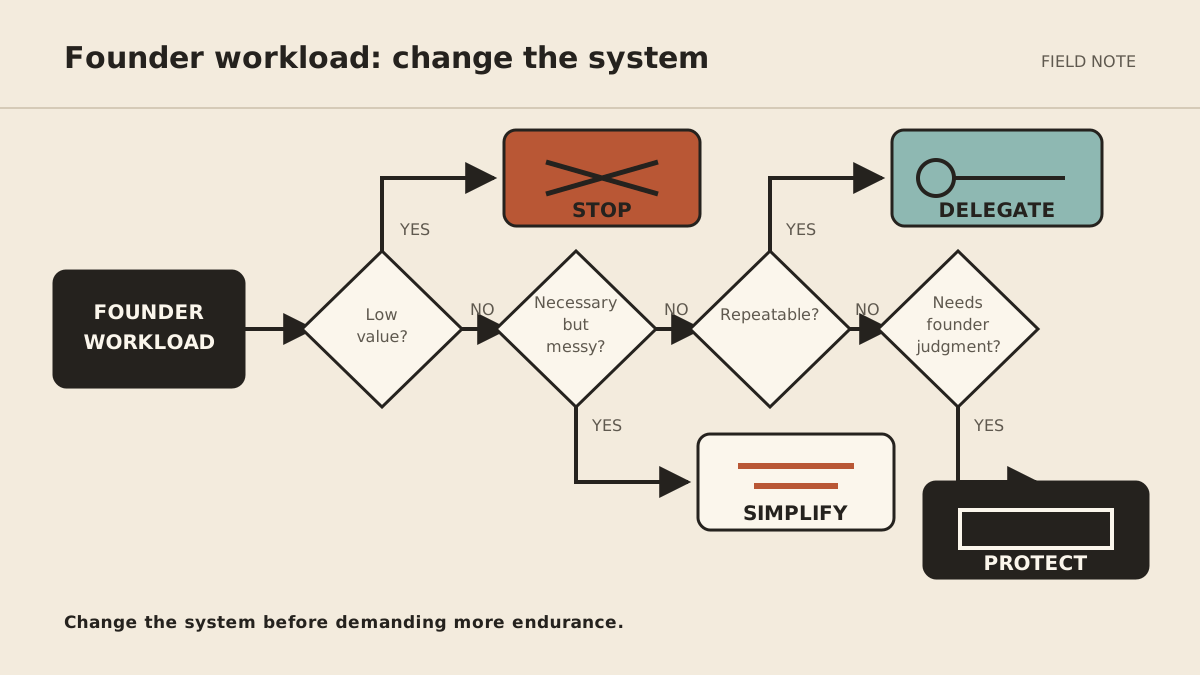
Use four gates: stop, simplify, delegate, protect
The order matters. Delegating a low-value task preserves a task that should not exist. Automating a tangled process makes the tangle run faster.
1. Stop low-value work
Ask: What would happen if this did not occur for 30 days?
Pause reports nobody uses, recurring meetings with no decision, channels that do not produce learning or revenue, and standards you imposed without a customer need. Make the pause explicit and reversible. You are running an experiment, not declaring the task worthless forever.
2. Simplify necessary work
Reduce the number of choices, handoffs, and places where information lives.
A custom weekly update for every customer might become one template with three optional sections. Five intake paths might become one form and one emergency route. A report rebuilt from memory might become a saved view.
If the task still requires you after simplification, at least it now asks for less.
3. Delegate repeatable work
Delegate work when the outcome is clear, examples exist, and a mistake can be detected before it causes harm.
Start with preparation rather than consequential judgment: assemble meeting context, categorize an inbox, reconcile a task list, format a report, or draft routine follow-ups for approval. A freelancer, assistant, teammate, conventional automation, or managed agent may be the right owner depending on the work.
Write the handoff in one page:
- what starts the task;
- what a correct result contains;
- which sources may be used;
- what can happen without approval;
- what must be escalated; and
- how you will review the first ten results.
4. Protect founder-only work and recovery
Put product direction, sensitive relationships, major commitments, and other founder judgment into scheduled blocks. Give recovery the same protection.
This is not a claim that a calendar cures burnout. It is a way to stop routine work from silently consuming the capacity required for judgment and health.
Redesign one founder week
Suppose your audit shows a 57-hour week:
- 18 hours of product and customer decisions;
- 14 hours of email, scheduling, and follow-up;
- 9 hours rebuilding reports and searching for context;
- 8 hours of meetings;
- 8 hours of fragmented catch-up.
Do not target a perfect week. Target a believable reduction.
| Change | Weekly capacity returned |
|---|---|
| Cancel one unused report and one no-decision meeting | 2 hours |
| Replace ad hoc scheduling with three written rules | 2 hours |
| Create one source of truth for customer context | 3 hours |
| Delegate inbox triage and follow-up preparation in draft mode | 4 hours |
| Keep two 90-minute blocks free of messages | 3 hours of protected focus |
That plan does not guarantee recovery, and the estimates must be measured. It does change the system by removing work, reducing coordination, and creating boundaries you can observe.
The U.S. National Institute for Occupational Safety and Health emphasizes that workplace policies and practices are central to reducing burnout. Its guidance is written for healthcare organizations, but the systems principle travels well: do not place the entire burden on the exhausted person while leaving the work unchanged.
What to do this week
Choose actions small enough to complete while tired:
- Tell one trusted person that the workload is not sustainable.
- Remove one commitment before adding a recovery habit.
- Book the health appointment you have been postponing.
- Establish one daily period when work cannot reach you.
- Hand off one bounded, reversible task with a written approval boundary.
- Schedule a review in seven days and compare the workload, not just your intentions.
If the business cannot tolerate even one protected evening or one removed commitment, that is operational evidence—not a personal failure. The business needs redundancy, narrower promises, more capacity, or a different plan.
When to seek more support
Talk with a qualified health professional when symptoms are persistent, worsening, disrupting sleep or daily functioning, or difficult to distinguish from anxiety, depression, another health condition, or medication effects. A founder coach or peer group may help with work decisions, but they are not substitutes for clinical care.
If you may harm yourself or someone else, cannot stay safe, or are in immediate danger, seek immediate help from local emergency services or the nearest emergency department. Do not wait for a workload experiment to work.
Founder burnout FAQ
Is founder burnout different from ordinary job burnout?
The core pattern is occupational. Founders often face additional exposure because ownership, identity, financial risk, and work design sit with the same person. That makes system changes both more available and harder to initiate.
Can a vacation fix burnout?
Time away may provide needed recovery, but the effect is unlikely to last if the same hours, ambiguity, and workload return unchanged. Use time away to recover, then change the operating conditions that made recovery impossible.
What should a solo founder delegate first?
Start with frequent, low-risk work whose result is easy to inspect: scheduling, information gathering, inbox categorization, report preparation, or follow-up drafts. Keep consequential decisions and sensitive relationships with a human owner. The solo-founder delegation guide includes a one-page handoff process.
Can AI prevent founder burnout?
No tool prevents or treats burnout. Automation can reduce a defined piece of recurring administrative work, but it can also create more review and maintenance if the task is poorly chosen. Measure the total workload after setup, including supervision and exceptions.
Make the next week lighter, not merely better organized
The useful first move is subtraction. Stop one task, simplify one process, delegate one bounded routine, and protect one recovery window. Review the effect after a week. If your health or ability to function is suffering, involve a qualified professional as well.
MyAgnts is one option for recurring digital administration that has a clear finish line and approval boundary. No task prep is required for a workflow call; we can learn how the work happens and identify a practical candidate together. Keep health decisions with people qualified to make them.