Guides
Competitor Price Monitoring: A Practical Small-Business Guide
Build a useful competitor price monitoring system: choose what to track, set meaningful alerts, protect your margins, and respond without panic.

Competitor price monitoring is a simple habit: track a small set of rival offers, get alerted when something meaningful changes, and decide what to do using your own costs and strategy. It should give you time to think. It should not turn every competitor discount into an emergency.
For a small business, the useful version is narrower than most software demos suggest. You may need to watch five competitors and 20 important products—not the entire internet. Start there, define which changes matter, and ignore the rest.
Start with this 30-minute setup
If you want a working system before the end of the day, do these four things:
- Choose three to five competitors that customers genuinely compare with you.
- Select the products or services that affect the most revenue or customer decisions.
- Record the full offer: price, shipping, availability, promotion, and package size or scope.
- Set one or two alert rules, such as “tell me when the delivered price changes by at least 8%.”
That is enough for a useful first version. You can add sophistication after the alerts lead to better decisions.
What competitor price monitoring should track
A number without context is easy to misread. A rival may appear cheaper because their package is smaller, shipping is extra, or the displayed price requires a subscription. Track the offer a customer actually sees.
| Field | Why it matters |
|---|---|
| Listed price | Establishes the visible starting point |
| Shipping or service fees | Reveals the real customer cost |
| Package size or scope | Makes like-for-like comparison possible |
| Stock or availability | Shows whether the offer can actually be bought |
| Promotion terms | Separates a temporary sale from a permanent move |
| Last checked | Tells you how fresh the observation is |
| Source URL | Lets a person verify the change before acting |
For services, replace package size with scope: turnaround time, included revisions, contract length, support level, or another unit that makes the offers comparable.
A starter tracker you can copy
You do not need a complicated dashboard. A spreadsheet with these columns works:
Competitor · Offer · Current total price · Previous total price · Change · Promotion ends · Availability · Source · Checked at · Action
Add one row per offer, not one row per competitor. If the same company sells three packages that matter to you, those are three separate rows.
Choose competitors by customer behavior
The largest company in your category is not automatically your most useful benchmark. Monitor businesses that show up in actual sales conversations:
- The alternative customers mention before buying
- The company that appears beside you in local or marketplace results
- A lower-priced option that wins budget-sensitive buyers
- A premium option that shapes expectations at the top of the market
- A substitute that solves the same problem in a different way
Ask your team one question: “Who do customers compare us with when price becomes part of the conversation?” The answers are usually better than a generic industry list.
Review the list quarterly. A competitor who mattered last year may be irrelevant now, while a new marketplace seller or local operator may deserve attention.
Set alerts that protect your attention
“Tell me whenever any price changes” sounds thorough and quickly becomes noise. Create thresholds based on decisions you might actually make.
| Signal | Example rule | Possible response |
|---|---|---|
| Material price drop | Delivered price falls 8% or more | Verify terms, then review positioning |
| Stockout | Key item becomes unavailable | Promote your in-stock alternative |
| Promotion | Sale appears with an end date | Decide whether to hold, bundle, or run a limited test |
| Price increase | Rival raises a comparable offer | Recheck your own pricing headroom |
| Package change | Same price, less quantity or scope | Update comparison messaging |
Use percentages only as starting points. An 8% move can be immaterial in a high-margin category and serious in a thin-margin one. A good threshold reflects your gross margin, customer sensitivity, and the cost of changing prices.
Pick the lightest monitoring method that works
There is no prize for buying the most elaborate tool.
| Method | Best for | Tradeoff |
|---|---|---|
| Manual weekly check | A few stable offers | Cheap and easy, but dependent on memory |
| Page-change alerts | Public pages with predictable layouts | Fast setup, but alerts may include irrelevant page edits |
| Spreadsheet plus automation | A focused list and a regular digest | Flexible, but needs careful source and error handling |
| Dedicated pricing platform | Large catalogs or frequent repricing | More coverage, cost, and operational complexity |
Whichever method you use, keep a human-verifiable source with every alert. Websites change layouts. Taxes, regional settings, cookies, membership prices, and out-of-stock substitutions can all create false signals.
Automated checks should also respect a site's terms, access controls, and published crawling instructions. Do not bypass logins, technical restrictions, or rate limits. When a reliable feed, partner API, or authorized data source exists, prefer it to brittle page scraping.
What to do when a competitor changes price
First, verify the change. Then slow the decision down just enough to protect your economics.
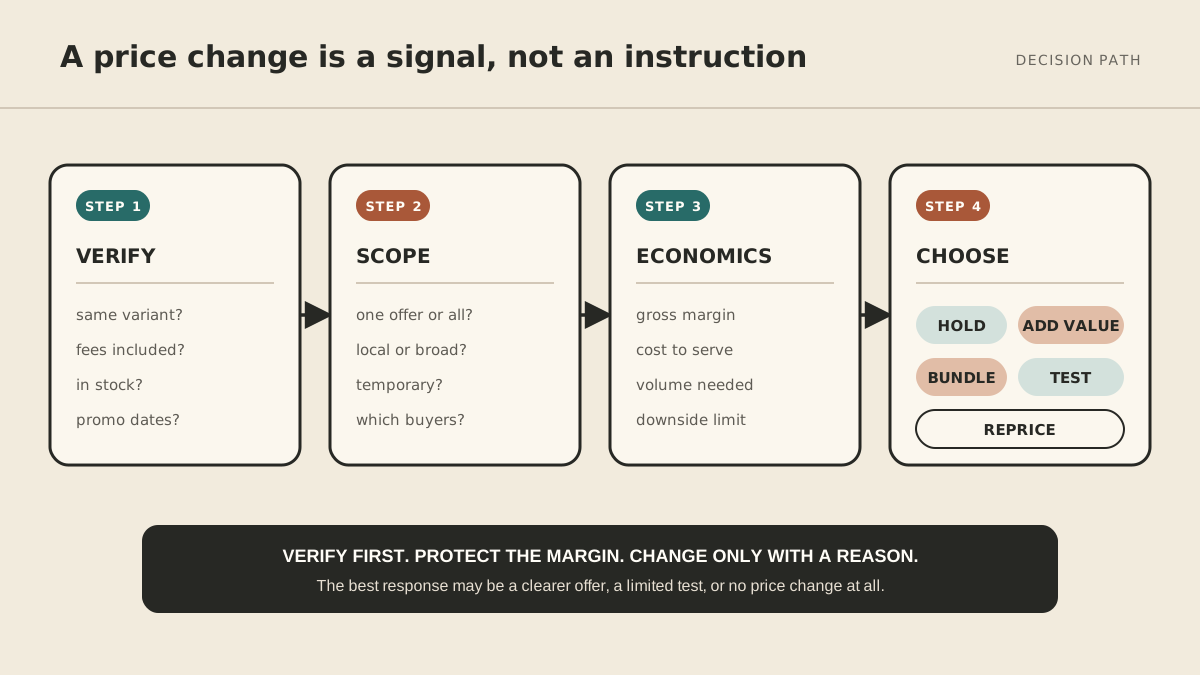
1. Verify the offer
Open the source. Check the variant, location, shipping, promotion dates, membership requirements, and availability. Capture a screenshot or note the observed terms so the decision has a record.
2. Identify the scope
Is this one product, one region, one customer segment, or the entire catalog? Is it a weekend promotion or a permanent list-price change? A narrow test should not trigger a company-wide response.
3. Check your own unit economics
Before lowering a price, calculate the margin after payment fees, fulfillment, returns, sales commissions, and support. Then estimate how much additional volume you would need to earn the same gross profit.
For example, suppose a product sells for $100 and has $70 in variable costs. Gross profit is $30. Cutting the price to $90 reduces gross profit to $20, so you would need to sell 50% more units to generate the same total gross profit. That is a much higher bar than “match the competitor.”
4. Choose a deliberate response
Your options include:
- Hold: The rival's offer is temporary, unavailable, or aimed at a different buyer.
- Clarify value: Make delivery speed, service, warranty, quality, or convenience easier to compare.
- Bundle: Add something valuable with a low incremental cost instead of cutting the headline price.
- Test: Run a limited offer for one segment, channel, or time period and measure the result.
- Reprice: Change price when the evidence and unit economics support it.
The right response is often no price change at all.
Keep pricing decisions independent
Monitoring public offers and independently deciding your own price is normal competitive behavior. Coordinating prices with a competitor is not. The Federal Trade Commission's price-fixing guidance makes the distinction clear: each company must establish prices and competitive terms on its own, without an agreement or coordination with competitors.
Do not use a monitoring process to invite, signal, or negotiate a shared pricing plan. If your situation involves sensitive nonpublic data, industry exchanges, or direct communications with competitors, get qualified legal advice.
Turn alerts into a weekly decision brief
Real-time alerts are useful for genuine exceptions. Everything else belongs in a short weekly review.
A useful brief answers:
- What changed?
- Is the change verified?
- How large and how broad is it?
- Does it affect a high-value offer?
- What decision, if any, is needed?
- Who owns the next step?
This is a good candidate for small-business automation. A rules-based workflow or private agent can collect approved public observations, compare them with the last check, and prepare a digest. Keep price changes behind an explicit approval boundary; an agent can surface evidence, but a person should own the commercial decision. Our guide to AI agent approval boundaries explains how to separate routine monitoring from consequential action.
Measure whether the system is worth keeping
After a month, review four numbers:
- Alerts received
- Alerts verified as meaningful
- Decisions or tests created
- Measurable outcomes, such as protected margin, recovered sales, or faster sell-through
If 40 alerts produce one useful decision, tighten the rules. If important changes still arrive through customers first, improve coverage or frequency. The goal is not maximum data. It is better decisions with less manual checking.
Frequently asked questions
How often should a small business check competitor prices?
Match the frequency to how quickly a change could affect a decision. Weekly may be enough for local services or stable catalogs. Daily checks can make sense for active promotions or fast-moving products. Start slower than you think, then increase frequency only where stale information has a real cost.
What is the best competitor price monitoring tool?
The best tool covers the offers you care about, preserves the source, filters small changes, and fits the person who must respond. Manual checks can be enough for a short list. Dedicated platforms make more sense when you have a large catalog, multiple regions, or frequent repricing.
Is competitor price monitoring legal?
Observing public offers and setting your own prices independently is generally part of ordinary competition in the United States. The important legal boundary is coordination: competitors must not agree to raise, lower, stabilize, or otherwise fix prices. Website terms, access restrictions, privacy rules, and laws vary, so obtain legal advice for your specific collection method or jurisdiction.
Should I automatically match a competitor's lower price?
Usually not. Automatic matching can amplify a temporary promotion, compare unlike offers, or destroy margin without producing enough additional volume. Verify the offer and check your economics before changing anything.
Build the smallest useful version
Choose five competitors, 20 offers, and two alert rules. Run the process for a month. Keep the sources that lead to decisions, remove the noise, and let the system grow only when the business case is clear.
If you want help turning a recurring monitoring brief into a managed workflow, see how MyAgnts works. The valuable part is not another dashboard. It is having the right evidence ready when a real decision lands.