Guides
How to Write a Cold Email Worth Replying To
Write a cold email that is relevant, truthful, easy to evaluate, and easy to decline—with a send-or-stop checklist, template, and follow-up rules.
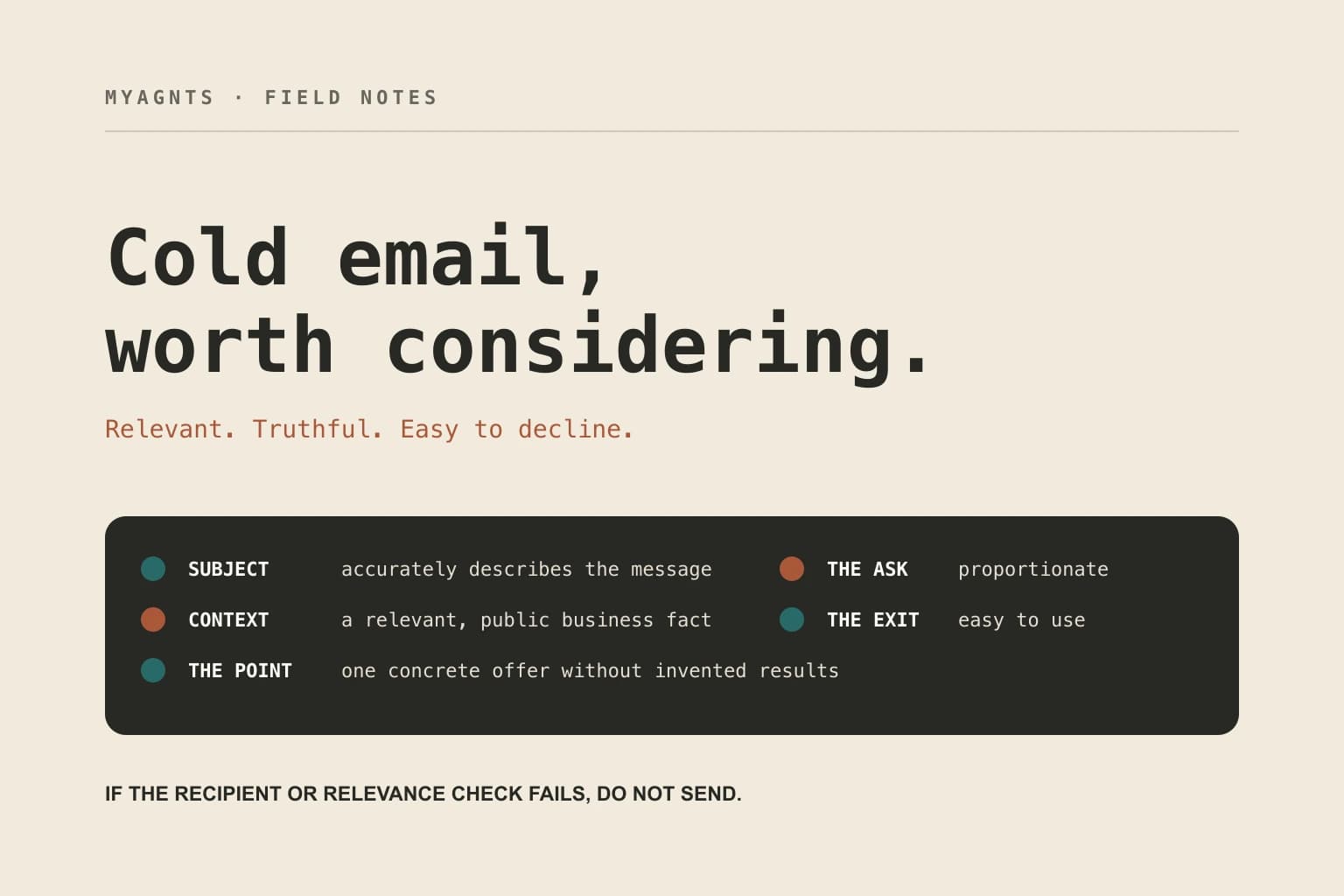
No wording guarantees a reply to a cold email. The recipient may be busy, satisfied with their current approach, or simply uninterested. Your job is to make the message easy to understand and easy to decline without wasting their time.
A good cold email identifies a real reason for contacting this person, connects that reason to a concrete offer, and asks one proportionate question. It also identifies the sender honestly and respects opt-outs. Clever phrasing cannot rescue poor targeting or an offer the reader does not need.
Run this send-or-stop check first
Before drafting, write one sentence for each line:
| Check | Send when | Stop when |
|---|---|---|
| Recipient | This person or role can reasonably evaluate the offer | You only know that the company exists |
| Relevance | A recent, public business fact connects to your work | The “personalization” is a hobby, birthday, or other irrelevant detail |
| Problem | You can describe a plausible operational issue without pretending to know private facts | Your opener asserts a pain, budget, or priority you cannot verify |
| Offer | You can name a small, concrete next step | The message depends on vague claims about growth or transformation |
| Identity | The sender, business, and reason for writing are clear | The subject or display name imitates an existing conversation |
| Exit | The recipient can decline or opt out without friction | Your sequence continues regardless of their response |
If the message fails the recipient or relevance check, do not improve the copy. Remove the contact from the sequence.
The four parts of a useful cold email
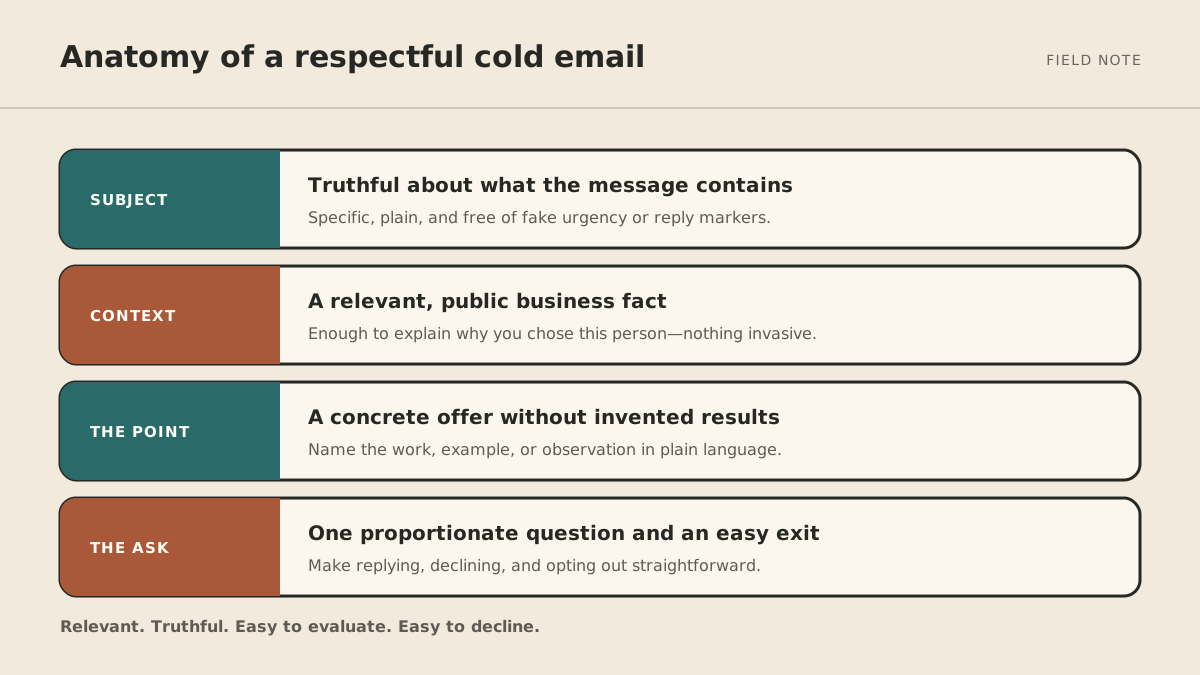
1. A truthful subject
Write a subject that accurately describes the message: question about intake at North Street Studio or overflow bookkeeping for August. Skip false reply markers, fake urgency, and subjects that conceal a sales message.
2. Relevant context
Use one public business fact that explains why you chose the recipient. “I saw you opened a second location” is context. “Congratulations on seven years at the company” is often trivia. The detail should lead naturally to the reason for writing.
3. A concrete point
Explain what you can offer in plain language. Replace “We help organizations unlock operational excellence” with the actual work: “I map how inquiries move from the shared inbox into the CRM and set up a review queue for missing details.”
Do not invent a result. If you have evidence from comparable work, state exactly what was measured and under what conditions. If you do not, offer a relevant observation, example, or scoped first step instead.
4. One proportionate ask
Ask for the smallest response that moves the conversation forward: whether the issue is relevant, who owns it, or whether a short example would be useful. A meeting can be appropriate for a complex service, but it should not be the only way to learn what you are offering.
A cold email template you can adapt
This is a structure, not a mail-merge script. Fill it only with facts you have checked.
Subject: question about [specific business process or event]
Hi [Name],
I saw [relevant, public business fact]. I work with [specific type of team] on [plain-language problem], usually by [brief, concrete approach].
I noticed [one useful observation] / I can send [one small, relevant example]. Would that be useful, or is this not a priority?
[Name] · [Role and business]
[Required contact/address details and opt-out method]
Read it once from the recipient's side. Can they tell who you are, why you chose them, what you are offering, and how to say no? If not, add the missing fact rather than another adjective.
Follow up only when you can add context
A follow-up can be reasonable when the first message may have arrived at a bad time. It should make the decision easier: clarify the offer, add a relevant example, or close the loop. “Bumping this” adds work for the reader without adding information.
Keep a contact-level record of sends, replies, bounces, and opt-outs. Stop immediately after a decline or opt-out. Set a conservative sequence limit before sending; do not let an automation decide that silence means permission for endless follow-ups.
A simple final note is enough:
Closing the loop on this. If [specific issue] becomes relevant later, I am happy to send the example. I will not keep following up.
Compliance and deliverability are part of the workflow
This section is general operational information, not legal advice. Rules vary by location, recipient, message type, and industry, so review the requirements that apply to your campaign.
In the United States, the FTC says CAN-SPAM applies to commercial email, including business-to-business messages and individual emails. Its guidance requires accurate headers and subject lines, identification of advertising, a valid postal address, a clear opt-out method, and timely handling of opt-out requests. Hiring a vendor does not remove the sender's responsibility. Read the FTC's CAN-SPAM compliance guide before sending commercial outreach.
Mailbox providers add their own technical and abuse-prevention requirements. Google's current email sender guidelines require authentication for mail sent to personal Gmail accounts and impose additional authentication and one-click unsubscribe requirements on higher-volume senders. Provider rules change, so check the current documentation instead of copying a setup from an old campaign.
At minimum, the workflow should maintain:
- the source and reason for contacting each recipient;
- the approved message and sender identity;
- a suppression list shared by every sending tool;
- authentication and delivery monitoring;
- bounce, complaint, reply, and opt-out handling;
- an owner who can pause sending.
What an agent may prepare—and what a person should own
An agent can collect approved public business context, draft a message from a verified offer, check required fields, schedule an approved sequence, and surface replies. That does not make fully autonomous outreach a sensible default.
Define the boundary in advance. The agent may prepare research and drafts; a person approves the audience, claims, first send, sequence rules, and suppression logic. Replies that involve pricing, commitments, complaints, or ambiguity go to a person. The same act/ask/never pattern appears in our anatomy of a safe follow-up agent.
For service businesses, outbound email is only one possible workflow. If your real bottleneck is handling people who have already inquired, start with a bounded lead follow-up workflow instead of building a cold-outreach system.
The best cold email is not the one that tricks an open or forces a meeting. It is the one a relevant person can evaluate quickly, trust, and decline without friction.