Guides
How to Write a Business Proposal Clients Can Approve
Write a clear business proposal with a practical brief, explicit scope, assumptions, responsibilities, pricing, and one unambiguous next step.
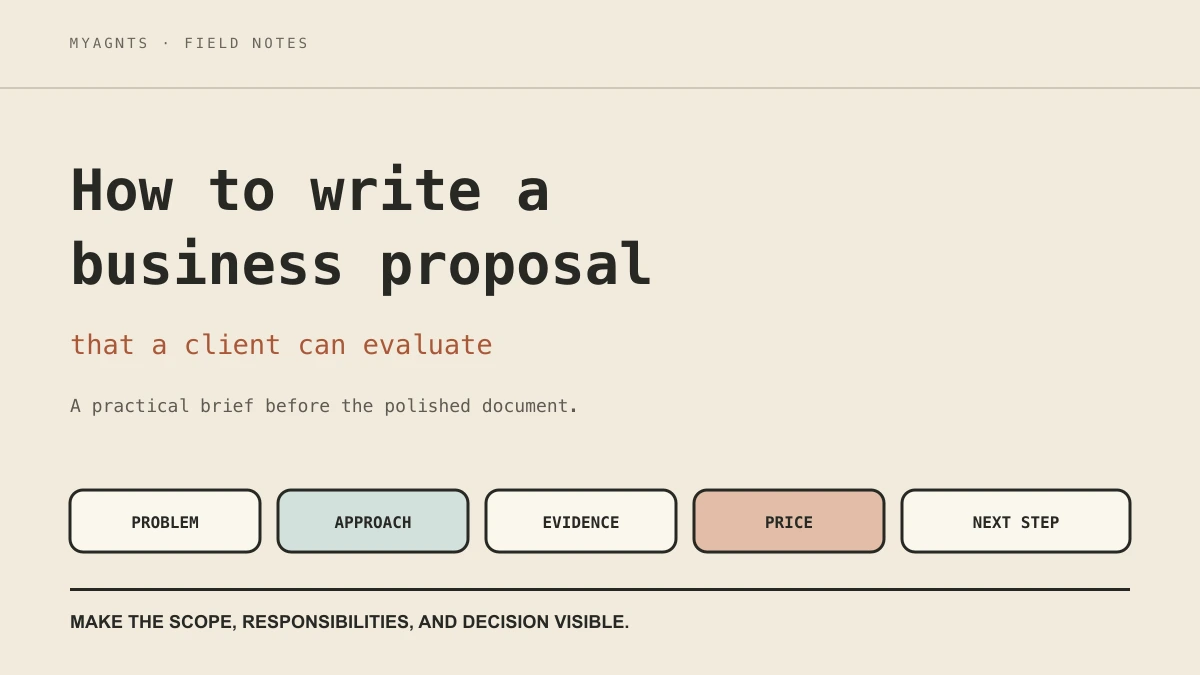
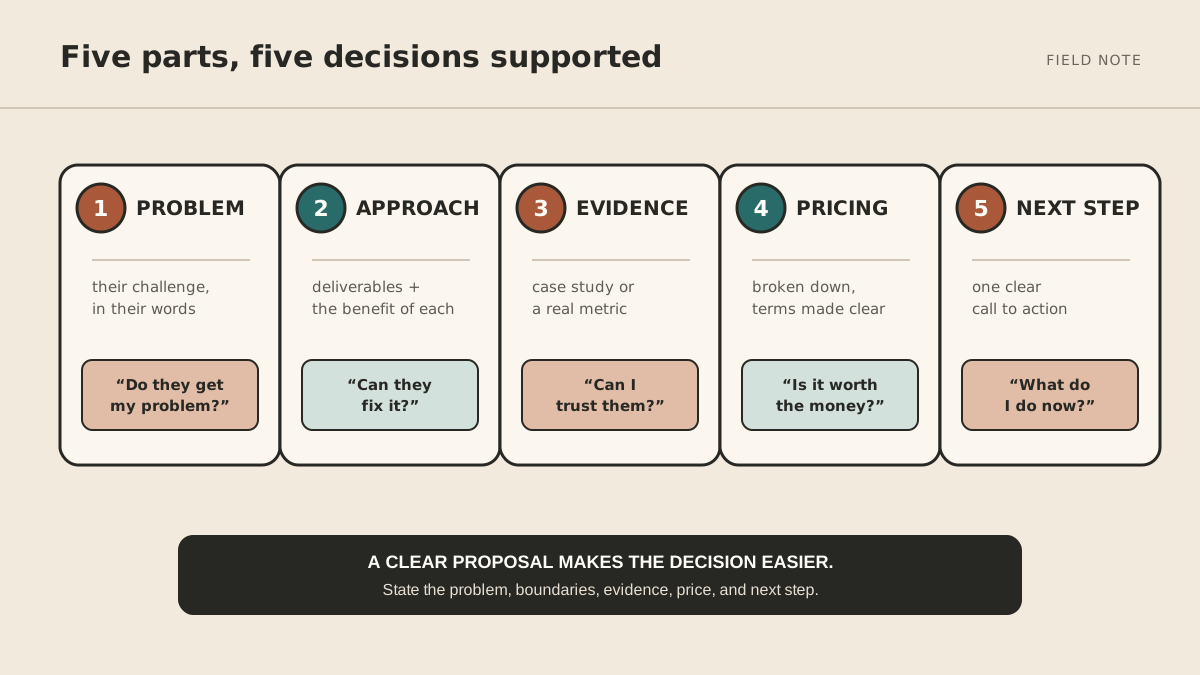
A business proposal should make a decision easier. It explains what you understand about the client's situation, what you will deliver, what each side is responsible for, how much it costs, and what happens next.
The writing gets much easier when you stop treating the proposal as a sales essay. It is a decision document based on a real conversation. If important details are still unknown, the honest next step is discovery, not a longer proposal.
Before you write, complete this proposal brief
Drafting too early is how assumptions turn into scope disputes. First, fill in this one-page brief from your call notes:
Client and decision owner: Who will approve the work?
Current situation: What is happening now, in the client's words?
Desired result: What should be observably different after the work?
Evidence: Which notes, files, measurements, or examples support that understanding?
Boundaries: What is explicitly included and excluded?
Client responsibilities: Which access, content, approvals, or people must the client provide?
Unknowns: Which questions could change the approach, timing, or fee?
Decision date: When does the client expect to choose?
If you cannot complete the current situation, desired result, or unknowns, send a short clarification instead of guessing. A polished misunderstanding is still a misunderstanding.
The seven sections of a clear business proposal
1. Context
Open with a short account of the situation and why the client is considering the work now. Use the language from the conversation. Do not inflate the problem or invent a financial impact you cannot support.
For example:
New inquiries currently arrive through two forms and a shared inbox. The team copies each inquiry into the CRM, then checks a spreadsheet before assigning an owner. Records are sometimes delayed or duplicated. You want one intake path and a visible exception queue before the September campaign.
That paragraph is more useful than a page of company history because the client can quickly confirm whether you understood them.
2. Proposed approach
Describe the work at the level needed to evaluate it. Name the major stages and explain why each one exists. Avoid burying the reader in your internal process.
A simple approach might be:
- map the current inquiry flow and edge cases;
- define required fields, ownership, and approval rules;
- build and test one intake route using historical examples;
- run a controlled pilot;
- document the handoff and review the pilot results.
3. Deliverables and boundaries
List tangible outputs. Pair each deliverable with a completion check, then state exclusions close by.
| Deliverable | Complete when |
|---|---|
| Current-state workflow map | The client confirms the sources, decisions, and owners |
| Intake configuration | Required fields and validation rules pass agreed test cases |
| Exception queue | Every stopped record shows a specific reason and owner |
| Handoff guide | A named operator can review, retry, and escalate records |
Then add a direct boundary such as: “This proposal does not include CRM migration, custom reporting, or changes to the client's consent language.” Exclusions should not be hidden in fine print.
4. Responsibilities and assumptions
Projects often depend on client access, feedback, source material, or a third-party vendor. Put those dependencies in the proposal.
Write assumptions so they can be checked: “The client will provide a CRM sandbox and ten representative inquiry records by August 18” is useful. “The client will cooperate as needed” is not.
5. Evidence and relevant experience
Use the smallest amount of proof that helps the client assess risk: a comparable project, a sample deliverable, a reference, or a verified result. Label demonstrations and hypothetical examples honestly. If you do not have a matching case study, explain the relevant method and how you will reduce risk during the pilot.
6. Schedule, fee, and change process
Show milestones, dependencies, and the fee in the same section. State what is fixed, what is estimated, when invoices are due, and how work outside the agreed scope will be approved.
Pricing does not have to be split into three packages. Offer options only when they represent meaningful differences in scope or risk. Cosmetic tiers create more reading without helping the decision.
7. Acceptance and next step
End with one action and a date: reply with approval, sign through the chosen system, or schedule a scope call for the listed unknowns. A proposal is not a contract unless your process and documents make it one, so say what acceptance actually does.
A copyable business proposal outline
Use this as a starting point, then remove anything the decision does not need.
Proposal for: [client / project]
Prepared by: [name]
Date: [date]
Decision owner: [name / role]
Valid until: [date, if applicable]

1. Context
[What is happening now and why this work is being considered]

2. Desired result
[Observable outcome, without unsupported guarantees]

3. Proposed approach
[Stages of work and why they are needed]

4. Deliverables
[Output] — complete when [acceptance check]

5. Scope boundaries
Included: [items]
Not included: [items]

6. Responsibilities and assumptions
Provider: [items]
Client: [access, content, approvals, dates]
Assumptions: [items that affect scope, timing, or fee]

7. Schedule and fee
[Milestones, dependencies, price, payment terms]

8. Changes
[How additional work is estimated and approved]

9. Next step
[One action, owner, and date]
Proposal, scope of work, quote, or contract?
The names vary between businesses, but these documents usually do different jobs:
- A proposal explains the problem, recommended approach, scope, evidence, fee, and next step.
- A scope of work defines the work, deliverables, responsibilities, schedule, and acceptance criteria in operational detail.
- A quote prices a well-defined request without making a longer case for the approach.
- A contract records the binding terms agreed by the parties.
They can be combined, but do not assume a proposal provides the legal terms your work requires. Use a qualified professional for legal advice about your agreements.
Review it like the client will
Before sending, read only the context, deliverables, fee, and next step. Can you answer these questions without filling in gaps from memory?
- Did the proposal describe the right problem?
- Can the client tell what they will receive?
- Are exclusions, dependencies, and responsibilities visible?
- Does every result claim have support?
- Is the total commitment clear?
- Does the client know exactly what to do next?
Then check names, dates, arithmetic, links, and version history. Save the approved proposal with the source notes that informed it.
Where an agent can assist without owning the decision
Proposal assembly is repetitive: gather call notes, select the current service description, insert approved pricing, check for missing fields, and prepare a follow-up reminder. A managed agent can coordinate those steps when the source material and permissions are explicit. A person should still confirm the client's problem, scope, evidence, fee, and final send.
That pattern—automation for preparation, human approval for consequential commitments—is one example of choosing a bounded workflow for a service business. If your proposal process is inconsistent, fix the brief and source documents before adding an agent.
A strong proposal is not the one with the most persuasive language. It is the one both sides can read later and understand the same way.