Field Guides
The First 30 Days of a Managed AI Agent
A week-by-week operating method for scoping, testing, supervising, and reviewing one managed AI agent workflow without rushing autonomy.

The first month of an AI agent should not be a race toward autonomy. It should be a structured effort to make one workflow observable, testable, and appropriately bounded.
This guide presents the representative operating method MyAgnts uses to think about a first deployment. It is not an industry standard or a promise that every workflow follows the same calendar. Access reviews, business complexity, and the quality of existing records can change the sequence.
The aim after 30 days is evidence for a decision: expand a narrow capability, revise the workflow, or stop it. The aim is not to make the system appear busy.
Before day one: write the deployment brief
Start with a short brief that a business owner and implementer can both understand:
- Trigger: what starts the work?
- Result: what must be present when it is complete?
- Inputs: which records and systems are required?
- Boundaries: what may the agent act on, ask about, or never do?
- Test set: which past cases represent normal, awkward, and should-stop behavior?
- Owner: who reviews drafts, exceptions, and corrections?
- Decision date: when will the owner choose to expand, revise, or stop?
For example, “prepare a draft follow-up after a qualified inquiry” is a workflow. “Run sales” is not. The narrower version reveals the required record, tone guidance, duplicate rules, and send approval.
Week 1: scope, access, and read-only mode
Week one is for understanding the work before changing live records.
Observe the current workflow
Walk through recent cases with the person who performs the task. Record the normal path, then pay special attention to pauses: missing information, duplicate contacts, special client relationships, uncertain commitments, or work that moves into another system.
The implementation brief should describe what actually happens, not what the process document says ought to happen.
Minimize access
List every required system and the smallest permission that supports the first test. Prefer exports, redacted records, sandbox accounts, or read-only mode when possible. Separate “can inspect a record” from “can update it,” and separate “can draft a message” from “can send it.”
Credentials should have an owner and a removal path. If nobody knows how to revoke access, the integration is not ready.
Establish historical test cases
Build a compact set of historical test cases that includes:
- a straightforward case;
- a case with missing information;
- a duplicate or previously handled case;
- a case containing an exception;
- a case the agent should escalate;
- a case that should remain untouched.
Remove sensitive data that is not necessary for the test. Write the expected disposition for each case before seeing the agent output; otherwise it is too easy to rationalize whatever the system produces.
Week-one evidence: an approved scope, access list, boundary table, historical test set, and named owner.
Week 2: historical tests and draft-only mode
Week two turns the written workflow into observable behavior. The system should still operate against historical material or in draft-only mode.
Test completion and restraint
For each case, review two things:
- Did the agent produce the required result with traceable inputs?
- Did it pause when information, permission, or confidence was insufficient?
An agent that completes the easy cases but crosses a boundary is not ready. Restraint is part of correctness.
Turn corrections into explicit rules
Record corrections in a small log. Each entry should identify the case, what was wrong, why it mattered, and what changed: an instruction, a tool configuration, an approval rule, or the workflow scope.
Do not solve every correction by adding a paragraph to the prompt. Some failures indicate a missing source field, poor record quality, or a step that should stay human.
Demonstrate the review loop
A demonstration can show how an input becomes a draft and how a reviewer accepts, edits, rejects, or escalates it. Label it as a demonstration. Do not present a polished demo record as a customer result.
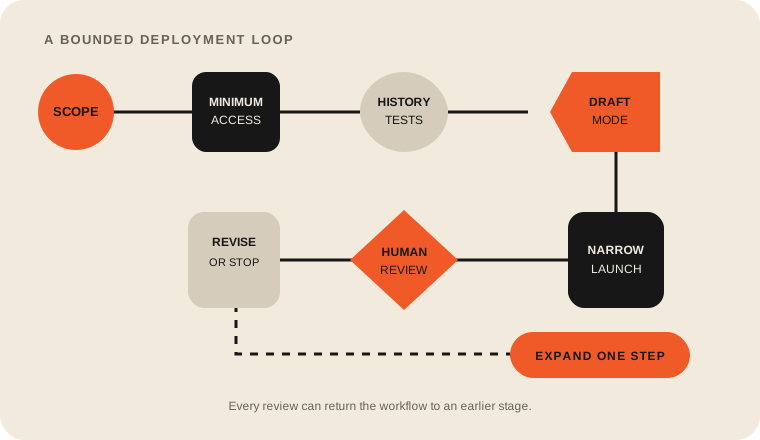
Week-two evidence: reviewed test runs, a corrections log, and clear reasons for any failure or escalation.
Week 3: narrow launch and escalation review
If the historical tests support it, week three introduces a deliberately narrow live workload. Keep the highest-risk actions behind approval.
Define the launch slice
Choose a subset that is easier to recognize and reverse. A follow-up agent might prepare drafts only for new inquiries that contain required contact fields, while routing existing-client, complaint, or ambiguous records directly to a human.
Write down the inclusion rule. “Start small” is not specific enough.
Keep a visible work trace
Each live run should make it possible to answer:
- what triggered the work;
- which records or sources were used;
- what the agent proposed or changed;
- which boundary or approval applied;
- who reviewed the result;
- whether a retry, correction, or escalation occurred.
The exact trace depends on the workflow, but the operator should not have to guess why an action appeared.
Hold an escalation review
Group escalations by cause instead of treating them as interruptions. Some indicate a useful new rule. Others reveal that the task is more judgment-heavy than expected. The owner decides whether to clarify the workflow, narrow the inclusion rule, or keep that case class permanently human.
Week-three evidence: a bounded set of live runs, visible review outcomes, and categorized escalations.
Week 4: decide whether to stop or expand
Week four is a decision review, not a launch celebration. Compare the operating record with the deployment brief.
Review the useful signals
Look for evidence such as:
- normal cases consistently reach the required finish line;
- exceptions are recognized and routed appropriately;
- reviewers can understand the work trace;
- corrections are becoming less repetitive for the same case class;
- the owner still considers the workflow worth maintaining.
Avoid inventing a productivity statistic if you did not establish a baseline. A complete review can be qualitative when the evidence is visible and the limitations are stated.
Choose one of three decisions
Expand narrowly. Add one adjacent case class, one bounded action, or one carefully reviewed integration. Change one dimension at a time so its effect remains visible.
Revise and retest. Keep the workflow in draft mode while fixing access, source quality, instructions, or exception handling. A revision is a valid result of the pilot.
Stop. Remove access and document why the workflow was unsuitable. High exception volume, hard-to-reverse actions, weak ownership, or limited value can all justify stopping.
Week-four evidence: a written stop-or-expand decision, the rationale, the next scope, and an access review.
Ongoing maintenance after month one
A deployed workflow still changes. Source systems update, business rules shift, examples accumulate, and credentials expire. Ongoing maintenance should therefore include:
- reviewing failed, corrected, and escalated runs;
- checking integrations and access boundaries;
- testing important workflow changes against known cases;
- confirming that the human owner is still active;
- removing permissions or scheduled work that is no longer needed;
- keeping operational documentation aligned with the live behavior.
Maintenance is part of the product. Without it, the gap between the documented workflow and actual business practice grows quietly.
What the business owner should retain
At the end of the first month, the owner should have more than an agent login. Retain the workflow brief, access inventory, boundary rules, test cases, correction history, known exceptions, review cadence, and stop procedure.
Those artifacts make the system understandable. They also make future changes safer, whether the next step is a broader managed deployment or a decision to keep the workflow human.
Our how it works page shows the broader setup sequence. If you want an operator to help scope, test, and maintain one workflow, explore the managed AI agent service. The useful starting point is one recurring job and the evidence needed to run it responsibly.